

A Few Small Repairs
For twenty years, nobody felt they could fight back against institutions they didn't trust. Then came the data center buildout.


Several years ago I was back in Memphis for the holidays at a house party type of situation hosted by some friends I hadn’t seen in a while. Now, I recognize that people have a habit of evolving as they course through the currents of time, but I was nevertheless floored to hear my guy — famous for his closet of Rage Against The Machine tees and a certain abortive Greyhound Occupy Wall Street pilgrimage — announce confidently, as he cracked open a Pabst in the dining room, that “the real problem with America is socialism.”
In retrospect it may have been telling that a couple of other dudes chose that precise moment to hit the punch jug, but I had to know what the deal was. So I moseyed over his direction and asked him to lay the take on me.
Well. Quickly I ‘learned’ that WeWork was a giant scam (this was around the time of the Adam fiasco), Facebook was spying on everyone, Theranos had blown up in everyone’s beturtlenecked faces, and Jeff Bezos was conspiring to leave Amazon soon to focus on turning the Washington Post into a propaganda machine1.
“Cool,” I said. “But, uh, what does that have to do with socialism?”
“There are all these billionaires in charge of everything, and we’re expected to just sit here and take it.”
Hmm.
“But,” I pointed out helpfully, “socialism is typically seen as government overreach, an intrusion by the state into facets of private everyday life. And everybody you just mentioned isn’t a politician — they’re all, like, CEOs.”
“Right, yeah,” he said. “But the thing is, it’s all the same.”
I feel in some ways like I’m conning y’all by publishing a Substack today, because easily the best use of everyone’s time is to stop reading this post and instead run — don’t walk — right over to this certified premium banger from Jasmine Sun.
What Jasmine did was go and talk to a bunch of different communities across America dealing with data centers in various ways — the politicians and activists and union laborers and regular ol’ people central to the process of getting them built or stopping them from getting built or generally just dealing with the fact of their existence.
I am a guy who is inclined to overstatement, so (as my wife will be the first to tell you) I’ve exhausted the credibility of any hyperbole I might be tempted to use. But I really do think Jasmine’s piece is the single best piece of journalism anywhere when it comes to meaningfully illuminating this issue.
A few weeks ago I wrote about how the data center fight is not really about AI — how the last time we ran this experiment, in the 1960s, the fracas ended only when the people behind the technology offered everyone else an assurance they could trust. I still think that’s right.
What Jasmine’s reporting illuminates, in a singular way, is what such assurance would actually have to be about2.
Data centers, she points out, have become focal points for a concept called thymos — a certain recognition of essential dignity and worth, as Frank Fukuyama and others have discussed in the political science literature. This is a close cousin of Arthur R. Miller’s description of the National Data Center as the “lightning rod for the vague feelings of discontent generated by the computer revolution”.
The key, Jasmine argues, is that in a climate where people primarily feel they’re subject to vast, powerful, inevitable forces beyond their reach, the social media debates and town halls that serve as the front lines of the data center fight function as — again citing Fukuyama — “stages for the expression of thymos” that matter in and of themselves.
Why this is important is: the expression of thymos is the operative thing. The actual policy objectives are secondary — not in the sense that they’re unimportant, but in the sense that none of them matter if the upstream variable of essential dignity and worth isn’t being recognized.
Jasmine draws this observation herself. “Until the deeper cultural problems are addressed, the data center backlash will only recreate itself in other forms,” she says. “If people are this angry at a building sitting and paying taxes on unused land, something deep has gone very wrong.”
Well. <David Attenborough voice> I submit to you that something deep has indeed gone very wrong.
Specifically: in an environment where the institutions that shape the texture of the world seem entirely unconcerned with the essential dignity and worth of regular people, regular people are going to do whatever it takes to make sure that dignity and worth get recognized.
And the data center fight is happening because these particular conditions actually favor fighting back.
But what can we do about those ‘deeper cultural problems’?
To understand what is and is not specific to any particular domain, it may help to Nightcrawler-warp away from the fraught, discourse-saturated space of data centers and towards the equally fraught, equally-discourse-saturated space of university academia.
It’s tempting, while here, to focus on the hottest-take scandal of the week, which involves a Cambridge professor named Jason Arday and a complicated web of escalating claims of philanthropic fundraising and instances of apparent plagiarism. Indeed, much of what assails academia is the increasing frequency with which scandals seem to be afflicting virtually every high-profile institution.
But the recent kerfuffle I think is most revealing when it comes to the data center phenomenon is last month’s widely-panned interview with Carolyn M. Rouse, President of the American Anthropological Association — a conversation occasioned by a report from ten high-profile scholars that singled out anthropology as the humanities’ “most extreme case” of politicization, and by the AAA’s full-throated rebuttal six days later.
The interview is worth chewing on — perhaps ironically — as an anthropological specimen of the state of…anthropology. Some choice excerpts include:
“So the idea that there are two sexes is just factually incorrect, and to force biological anthropologists to teach that is the equivalent of turning an astronomy department into an astrology department.”
“This is the problem with absolutist free speech. We talk in contexts. Speech is never free.”
“I don’t believe in opinion research.”
“So I disabuse students of a lot of presumptions, so we’re not an echo chamber, we’re not a podcast, we’re not funded by this mysterious organization called Antifa that doesn’t exist. Again, another fact, right? Can we stick with facts?”
I admit to feeling like I’m cheating taking these excerpts, as a whole extended section of the interview focuses on the problem with taking information out of context. Plus, I for sure am not an anthropologist. For all I know, each of these claims is perfectly defensible within the discipline. Some of them might even be true! So really, go read the whole interview.
Because from my perspective as a non-anthropologist, the fundamental problem with the interview doesn’t hinge on any one particular claim. The fundamental problem is that, as a whole, it reads as just insane to basically anybody who isn’t caught up in the discipline.
And I think that’s downstream of what happens to anyone who spends year after year inside discourse spaces where everybody takes the same set of premises as given. Irrespective of whether you win or lose any particular argument, you definitely lose the ability to hear what you sound like to anyone outside the circle3.
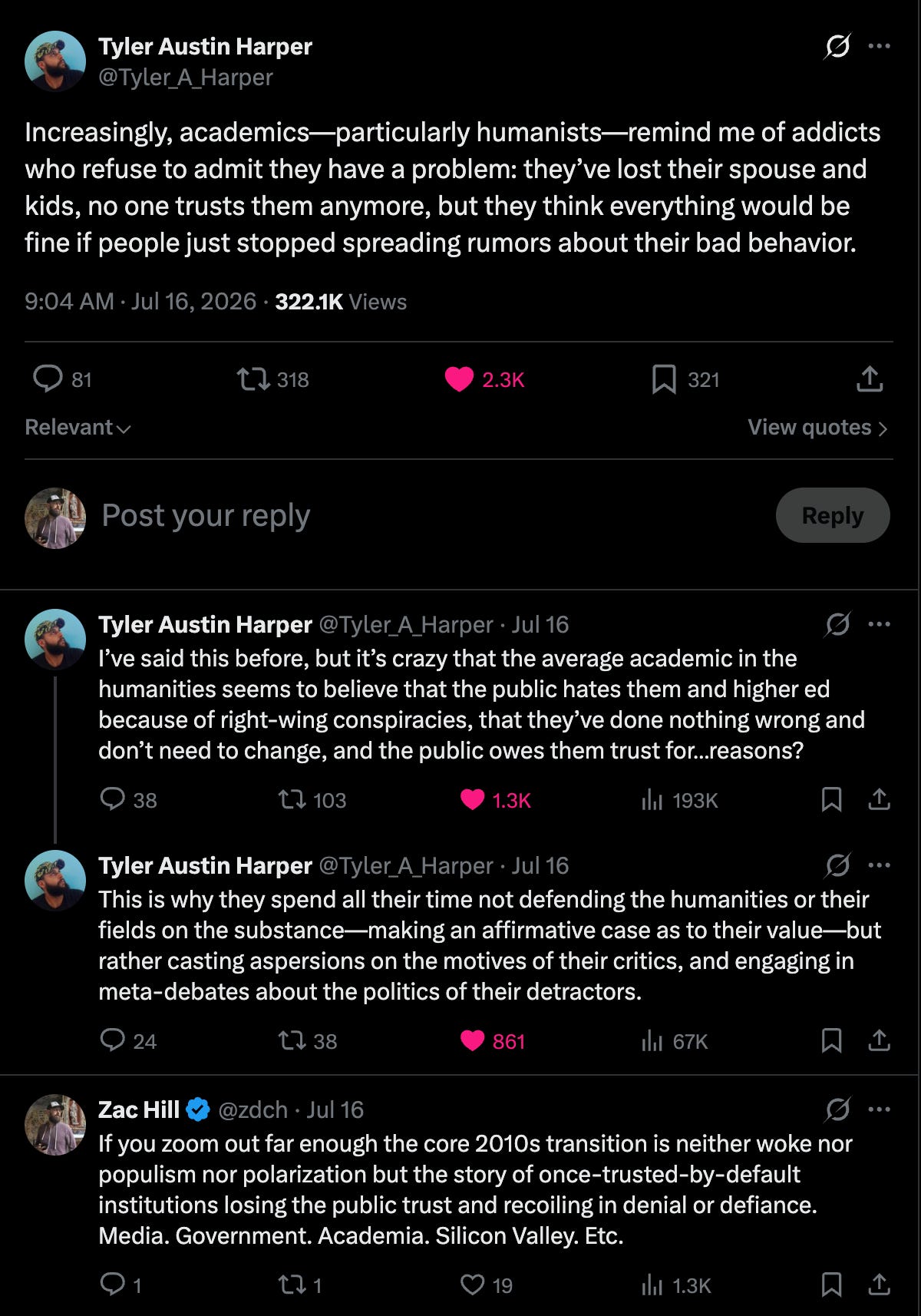
Tyler Austin Harper, who has been on top of this beat more thoroughly than almost anyone, captured the essence of the problem:
Columbia linguist John McWhorter followed suit, capturing the magnitude of insularity we just talked about:

Again: I am not an academic; I know nothing about anthropology; I agree with Rouse that there are many bad-faith critics of academia; and I have no especial bone to pick with any of the individuals involved.
I focus on this discourse because academia, like Silicon Valley, exerts disproportionate influence on virtually everybody in America, in a way that feels both inevitable and inescapable — and because academia, like Silicon Valley, possesses an extremely insular culture that’s virtually impregnable to outsiders.
Taken together, this leads to a situation where it’s easy for people ‘outside the circle’ to feel on the receiving end of something exceptionally alien.
And that’s why, if you take the diagnosis Tyler offers of academia and substitute Silicon Valley as the subject under examination, the result feels eerily apt. Let’s just walk through each dimension of the claim:
Having plummeted from the heyday of Obama-era “Don’t Be Evil” whiz kids, the tech sector flatly refuses to admit it has a problem. No one trusts it anymore, and hasn’t for a while4. High-profile figures within the sector whine and complain about how terrible it is that people don’t like them; Marc Andreessen has taken to national podcasts to lament that he no longer gets invited to dinner parties. There is tremendous aversion to any real structural change5, coupled with the assumption that they deserve to be trusted even though the public clearly doesn’t. Much of the public discussion about the value of AI winds up devolving into broader ideological contests about motives and the ensuing ‘meta-debates about politics’.
Above all, it’s not clear any major institution or institutional figurehead acknowledges they bear much responsibility for the problem at hand6.
In fact, it’s not clear that they see the problem as a problem at all. A salient exchange came as Nate Silver, discussing the recent run of impressive AI results on unsolved math problems, made the point that the labs aren’t really spending much bandwidth on things normal people care about. Leah Libresco Sargeant countered that the labs think they’re close enough to Recursive Self-Improvement that the median voter no longer matters very much.
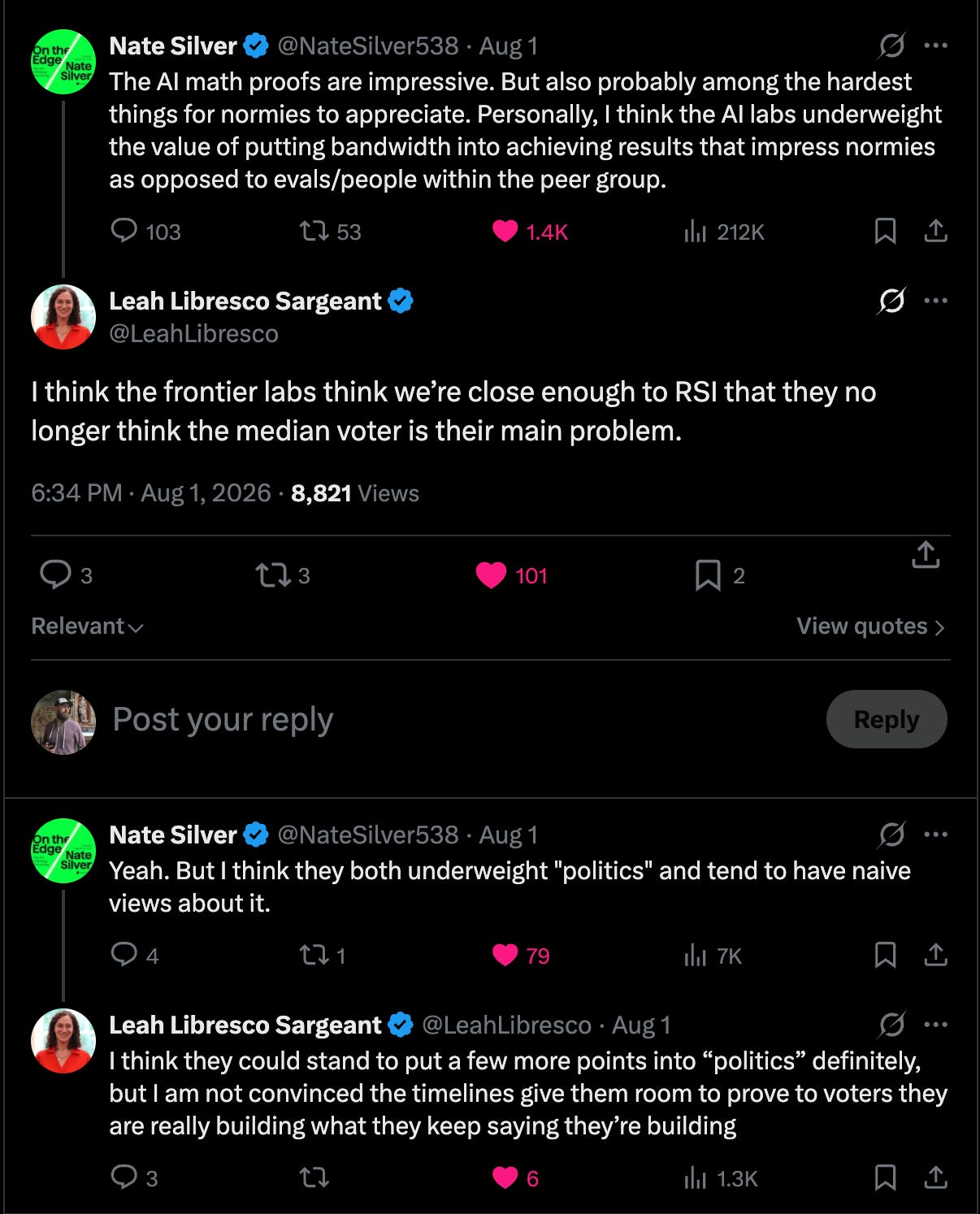
I’m not saying (my fellow DC denizen) Leah is speaking for everyone at the labs or anything. I am just saying that one lesson the tech sector might learn from academia involves how easy it is to believe you’re insulated from the political process — until the e.g. endowment taxes and the funding freezes and Ron DeSantis’s newfound interest in your course catalog reveal to you, quite suddenly, that you aren’t.
At the root of the ‘deeper cultural problems’ facing academic institutions is this complete lack of consideration of the thymos of regular people — the regular people whose tax dollars flow to major research universities; the regular people whose undergraduate educations both fund and legitimate the otherwise-esoteric pursuit of knowledge; the regular people who fork over literal years’ worth of paychecks only to be curtly informed that their most deeply-held values are just ‘presumptions’ in need of being ‘disabused’.
The thing is, it’s all the same.
Because what we’re seeing in Silicon Valley is a comically exaggerated version of exactly this phenomenon. Regular people are pouring things into the AI project too: the county land underneath the data centers; the electricity coursing through everybody’s grid; the collected written output of every human being who ever put pen to paper. Yet despite the fact that the impact of this buildout lands on millions of people who will never once touch the product, the question of how to get them onboard just isn’t treated with any kind of special urgency.
By contrast, here is a list of things that the median person I regularly chat with at an AI or tech-policy meetup believes and cannot stop talking about:
The technology being developed within the frontier labs has a countable chance of ending all life on planet Earth (morbidly, a sporting game to spark cocktail conversation involves assigning probabilities to the likelihood this happens).
One reason it’s worth pursuing the technology despite that existential risk is that it’s very possible, within our lifetimes, to cure all of the major infectious, genetic, and chronic diseases — and very possibly ‘cure’ death itself.
The white whale for the labs — something called ‘artificial general intelligence’ — can be measured in many different ways, but one very common definition involves being able to do any economically valuable work a human can do (which is to say, being able to replace a human at any given job).
The spiraling productivity resulting from an unlimited bounty of abundant, commodified intelligence is likely to create a ‘permanent underclass’ divided between the people who have access to the economic upside of AGI and those who don’t.
Almost everything we know about current digital security, cryptography, and privacy not only can but will be meaningfully and trivially subverted by anyone with enough access to compute — which is to say, every password, secret, and encrypted archive on Earth is ticking down like a timer in a Bruce Willis movie.
What is jaw-droppingly revealing about all of this is that — having arrived out loud at a host of conclusions with wild, society-altering implications — the immediate imperative does not become, “Wow, this is all kind of bananas; we need to start getting the American people onboard with the implications of all of this, and start generating broad political buy-in for the very different world we’re tasking ourselves with bringing about.”
It’s “we need to barrel forward so fast that there can’t be any especially meaningful inhibition to what we’re doing.”
There is, to be fair, a prominent movement to “pace” frontier AI development — a movement I personally support. But notice what the pacing is indexed to: capability. An industry-wide agreement to slow down when the models get scary enough. Nobody anywhere on the industry’s spectrum, accelerationist to doomer, has proposed pacing development until broad democratic legitimacy gets obtained.
Every proposed brake triggers on what the machines can do — not, as of yet, on whether the public has said “yes”.

In other words, no meaningful constituency within this movement is waking up and going to sleep every day with the thymos of regular people front and center.
To be clear: it’s not that there’s an active disregard for regular people. Many leading voices in the space are passionate about how AI can be used for straightforward, eye-level problems: starting businesses, navigating public information, signing your kid up for classes at school.
It’s just that all that stuff — the kinds of things that, for people like you and me, animate the pulse of our day-to-day lives — is ancillary to what motivates the endeavor as a whole.
Active antagonism, or passive indifference?
The thing is, it’s all the same.
At this point, I should lay my cards on the table: I am extremely pro-AI. I am extremely pro-data-center. I find most of the people I know at the labs extremely smart, earnest, lovely, and morally serious.
But I also completely get it.
One thing about a data center is that it’s big, it’s concrete, and it very clearly either exists or doesn’t.
You can’t just delete a sociology department. You can’t click “unsubscribe” from the federal government. There is no zoning board for cable news. For most of our long institutional ‘unwinding’, the only ways to fight back have been slow, diffuse, and indirect: Start complaining. Stop enrolling. Vote — and pray — for whoever promises to swing the biggest hammer.
But a data center is different. Like a dragon, a data center can be slain.
So regardless of the tax revenue, the education spending, or any other upside on offer, spiking a data center’s development is a loud, public, visible demonstration that the voice of a community cannot be ignored. That it MUST be recognized.
And that recognition is often intrinsically more valuable to a community — as Jasmine’s reporting deftly shows — than any particular policy objective.
Which brings me back to Leah's observation.
I think she's right about what the labs generally believe, if only implicitly — that voters are basically a bump in the road on the way to RSI7. But I also think the belief has a hole in it. Those timelines that supposedly put the labs beyond the median voter's reach run right through the median voter themselves. Recursive self-improvement requires compute; compute requires data centers; and data centers — as 833 opposition groups and one statewide moratorium have now demonstrated — require the consent of a whole lot of regular Americans who have recently discovered they can just say no.
What the burgeoning data center movement demonstrates is that the median voter is perfectly willing to become the labs’ main problem.
Thymos cuts both ways. Recognition, unlike compute, is not a scarce resource — it costs nothing to produce, and it fits inside any timeline. Even a short one.
Me, I keep thinking about my friend in that dining room, Pabst in hand — wrong about the piece of terminology, right about the nature of his experience. I saw on Facebook that he indeed has become an outspoken opponent of Colossus. No one powerful had ever asked him a thing, and as far as he could tell, no one was ever planning to. Government, billionaires, whatever.
The thing is, it doesn’t all have to be the same.
Prophecy or conspiracy? You choose!

Spoiler alert — laying out stacks of hunneds to try and make the problem go away doesn’t really work.
Lest it seem like I doth throw too many stones, I am a man who once convened an hour-long meeting featuring no fewer than four Ph.Ds from premier institutions to argue about the anatomical differences between a dragon (i.e. a fictitious creature) and a drake (i.e. another fictitious creature). I know what it be like.
Way back in 2014, TechCrunch itself ran a piece called "Silicon Valley Is Now Public Enemy No. 1, And We Only Have Ourselves To Blame" — citing George Packer's The Unwinding, no less.
The labs, to be fair, are veering in that direction — in stark contrast to the major advertising (sorry, "social media") companies — though even then in ways that tend to lock in their own incumbency advantages. See, e.g., Sam Altman's 2023 Senate testimony proposing a federal agency to license "any effort above a certain scale of capabilities", which critics immediately noted would function as a moat. By 2025, the ask had mellowed into "sensible regulation" that "does not slow us down.” Also, there is of course this year’s blunderbuss of various open letters.
You could run the same substitution on the media, by the way — a whole industry that responded to twenty years of collapsing trust mostly by blaming their own audience.
“Recursive Self-Improvement.” One of the most insufferable dimensions of the discourse is that everything has an acronym like this.
Tech Hyperscalers Yield Maximal Opposition Surface
Elon wants to put the data centers up in space so community meetings can't block them:
https://www.a16z.news/p/spacex-and-the-sentient-sun
That way when the rogue AI gets going, it will be totally infeasible to unplug it...