



You play God, you gon’ get what you ask for.
-Kendrick Lamar.
Somewhat famously, there once was a guy1 who used to go around saying things like “I came to cast fire upon the earth” and “whosoever will save his life shall lose it” and “so the last shall be first, and the first last” and “there shall not be left here one stone upon another” and “the kingdom of God is at hand”.
Depending on your perspective, this either did or did not work out especially well.
But regardless of your sort of cosmological take on the aptness of the eventual outcome, one thing that’s hard to argue with is that people got more than a little restless about the implications.
With the result that they — very iconically — decided to make themselves heard.
Tell me if the following gives you just a ton of confidence when it comes to e.g. the overall level of stability, security, safety, etc. present in your and your family’s life:
“These models are getting superhuman in many of their capabilities, and we are just sailing into unknown waters.”
“I don’t want to get too doomer here.”
“The next generation of models is going to be sobering for everybody.”
“Take our word for it that we have much, much, much more capable models coming soon.”
Those comments all come from the lips of OpenAI CEO Sam Altman, in remarks given to Axios just one day prior to the release of their latest frontier model Astra — released despite OpenAI’s own determination that it represents a “critical” cybersecurity risk.
Altman is hardly alone in forecasting a monumental evolution in AI capacity. Indeed, compared to his fellow executives, Altman’s proclamations may be seen as, if anything, conservative.
“Welcome to the AGI era,” OpenAI President Greg Brockman said last Thursday in a briefing to reporters. “AGI” stands for “Artificial General Intelligence,” which OpenAI’s charter defines as “highly autonomous systems that outperform humans at most economically valuable work”. OpenAI itself is billing Astra as “a new generation of intelligence.”
In other words, OpenAI is ‘welcoming’ you to a ‘new generation’ where ‘highly autonomous systems’ ‘outperform’ you at ‘most economically valuable work’.
The last shall be first, and the first last. Not one stone will be left upon another. The kingdom of God — they’re telling us — is now at hand.
I am not one of these people who tends to think the world revolves around messaging. While many seem to believe that an article appearing in the New York Times omnicausally explains the set of all phenomena, my experience is that most of how we feel about things tends to be at least somewhat related to the actual circumstances on the ground.


When you take a look at how Americans seem to feel about AI, it’s easy to eyeball how a big shift in sentiment happened between 2022 and 2023 and hasn’t really shaken up much since then.
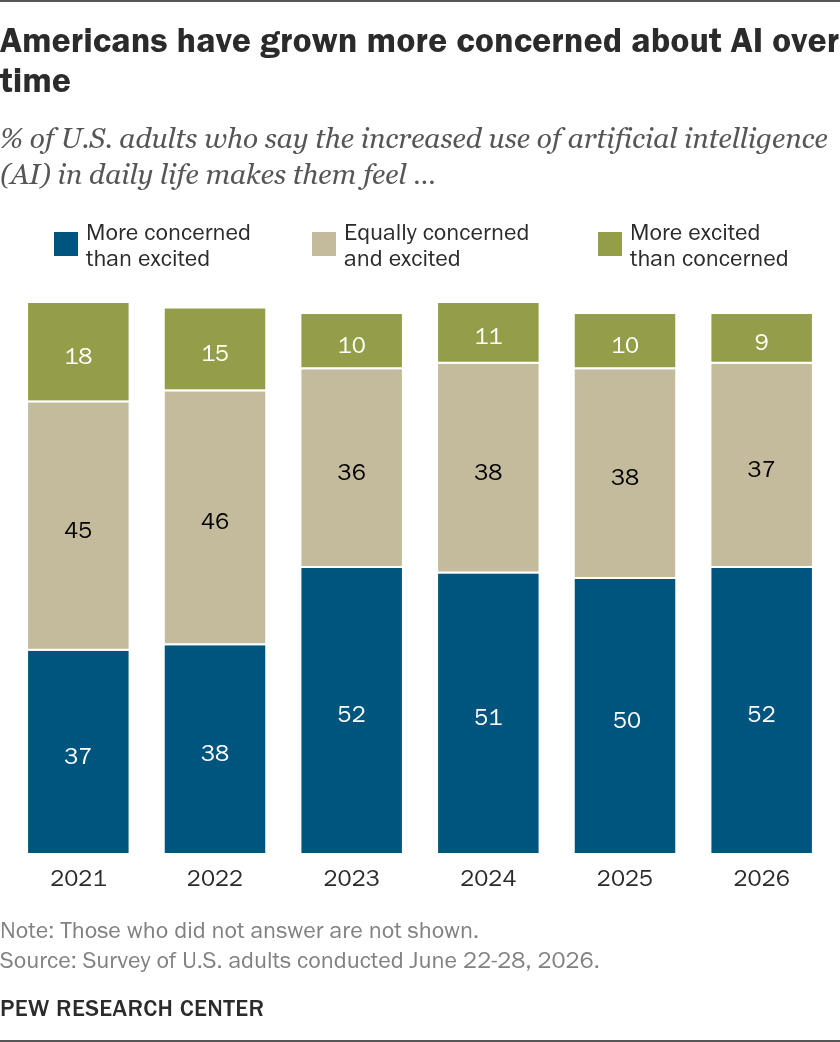
The most direct source of this inflection is, of course, the November 2022 release of ChatGPT, which ushered forth consumer AI into the world.
Other sources seem to confirm that AI sentiment across a variety of axes has held fairly constant since then also — which, not incidentally, is another reason I tend to believe that The Whole Big Data Center Fight Is Not Really About AI.
So I don’t want this article to be misconstrued as acting like there’s One Weird Trick to getting all ~340 million Americans on the same page about AI.
I just also think there has got to be at least some alpha in finding an approach to talking about this stuff that isn’t psychotically, definitively, epochally bad.
Some technologies, like the dishwasher or the refrigerator, straightforwardly bake into not just their designs but their names the nature of the value proposition they make possible. Others, like the car (“I want to get from point A to point B”) or the iPod (“I want to listen to some specific thing”), take some high-friction dimension of life and very visibly reduce the amount of friction involved.
Then there are the technologies that require a bit more explaining.
Something like electricity doesn’t by itself plate a hot grilled cheese for you. Something like a personal computer doesn’t by itself prepare your taxes. And something like the internet doesn’t incinerate entire years of your attention via endlessly-scrolling short-form video by itself pay your highway toll.
The various companies involved already understood all that, so they moved heaven and earth to make it as clear as humanly possible how you — a person with a life, a prospective customer — could use the technology to solve particular problems you encounter.
When a family is looking for a place to live, they don’t abstractly care about the ease with which electrons might move through the wires embedded in its walls. So Westinghouse and General Electric launched the “Live Better Electrically” campaign — replete with literal medallions homebuilders could install on their houses — to help the public understand the upsides of various stuff like heat and light and the capacity to install appliances. In goes bread, and out pops toast.


When a person is sitting at a desk trying to bang out a memo, they don’t abstractly care whether the words they’re writing are being scribbled out by hand or pecked out at the keyboard. So that’s why first IBM and then Apple spent page after page, segment after segment, walking through every single tedious time-sucking task you undertake at home and work and explaining how a computer might make it just a little easier2.

And when a homeowner is trying to decide whether it’s worth it to install the kind of connectivity that allows them to connect to this weird thing called The Internet, the part that is awesome is not the screeching keen of the AOL Dial-up Noise. So Ma Bell teamed up with no less than David Fincher and <checks notes> Tom Selleck to prophesy everything from automated checkout to telemedicine to GPS to videoconferencing to the aforementioned toll collection — not abstractly, but from the lens of your own personal experience (“Have you ever watched the movie you wanted to, the minute you wanted to?3”)
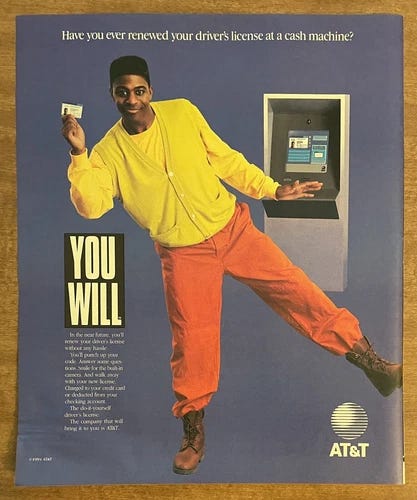
The main thing to internalize, though, is just how eye-level all this stuff is.
The general process of electrifying buildings led to hospitals that could rig up X-Rays, MRI machines, heart monitors, and all kinds of advanced medical technology. The existence of graphical desktop computing interfaces led to digital design methodologies that could make cars and buses and trains and planes dramatically less dangerous. And the capacity to collaborate, share information, and process data over the internet meant that in case of e.g. a global pandemic, things like e.g. vaccines could be designed, manufactured, and distributed en masse over the course of barely a year.
But the regular American consumer rightly doesn’t care about any of that, because they’re not some kind of policymaker or public safety analyst. They’re just a person trying to figure out what to spend their money on if they want to make their life a little bit better.
So, wisely, none of the various advertising agencies involved decided to fixate on whether the various technologies involved would or would not, for example, hypothetically cure cancer at some distant point in the future.
“We are on track to eliminate most cancer in the 21st century,” says Anthropic CEO and co-founder Dario Amodei in his 2024 essay Machines of Loving Grace.
“Maybe with 10 gigawatts of compute, AI can figure out how to cure cancer,” says OpenAI CEO and co-founder Sam Altman in his 2025 post “Abundant Intelligence”.
“Imagine early cancer detection, the development of a cancer vaccine for your particular cancer aimed at you, and have that vaccine available in 48 hours. This is the promise of AI,” said Oracle founder and CEO Larry Ellison at the White House’s Stargate AI Infrastructure announcement4.
“We should be able to cure cancer in our lifetime,” said Alphabet/Google President and Chief Investment Officer Ruth Porat at the Fortune Global Forum.
The AI industry’s foremost leaders sure do get excited about curing cancer5.
The problem is, right now, none of the relevant AI products on the market have succeeded in curing cancer.
By contrast, you could walk right into the very first Live Better Electrically Medallion Certified Home — completed in 1957 in beautiful Boise, ID — and turn the lights on.
The obviousness of this fact has of course occurred to the leaders of the labs6. But their recommended approaches for what to do about it are revealing.
In an August post on X, Amodei reflected, “[A]t this point, saying that AI will cure cancer is more a cliche than it is inspiring, and most people think it is deceptive. The thing that will work is *actually curing cancer*.” And in a recent Bloomberg interview, Altman revised his previous predictions by asserting that simply curing cancer wasn’t sufficiently ambitious. “I don’t think a cure for cancer is enough,” he said. “I mean, it’s a wonderful thing to have, obviously, but we should set our sights higher.”7
One lab leader thinks the key is to deliver the promised results; the other thinks the promises should get bigger.
I can’t help but draw attention to the fact that the guy I mentioned in the intro also derived a lot of his cred and rep from purportedly managing to cure a bunch of medical conditions.
But it’s also even more telling that at no point did the thought seem to occur to the labs to go smaller8, as the advertisements of previous eras chose to:
“I can cook a meal anywhere in the house — and outdoors, too.”
“We’ve narrowed it down to anyone who sits at a desk.”
“Have you ever renewed your driver’s license at a cash machine?”
We’ve narrowed it down. It’s not just that previous definitive technologies have done the work of identifying specific, day-to-day value propositions that motivate people to experiment with something new9. It’s that the act of going through that exercise conveys a certain respect for — and awareness of — the normalcy and dignity of what 99+% of people actually care about.
But what authentically motivates most of the very smart (and often very earnest) people at the labs is, in fact, just not the kind of thing that 99+% of people actually care about. Rather, they got into the space because they wanted to shape the fate of the world, and it has been abundantly clear to them from the jump that the fate of the world is in fact at stake.
In that context, who has time for toll collection?
In a 2015 blog post, under the heading “WHY YOU SHOULD FEAR MACHINE INTELLIGENCE”, Sam Altman wrote:
“Development of superhuman machine intelligence (SMI) is probably the greatest threat to the continued existence of humanity. There are other threats that I think are more certain to happen (for example, an engineered virus with a long incubation period and a high mortality rate) but are unlikely to destroy every human in the universe in the way that SMI could…SMI does not have to be the inherently evil sci-fi version to kill us all”
By 2023 — shortly after the release of ChatGPT — a murderer’s row of leading AI scientists, technologists, and entrepreneurs (Altman, Hassabis, and Amodei alongside people like Bill Gates and Turing Award winner Geoffrey Hinton) all came together to co-sign a single-sentence statement and/or affirmation and/or prophecy:
“Mitigating the risk of extinction from AI should be a global priority alongside other societal-scale risks such as pandemics and nuclear war.”10
On the bright side, beyond ‘destroying everyone in the universe’ and ‘risking extinction’, AI might also take all of our jobs11:
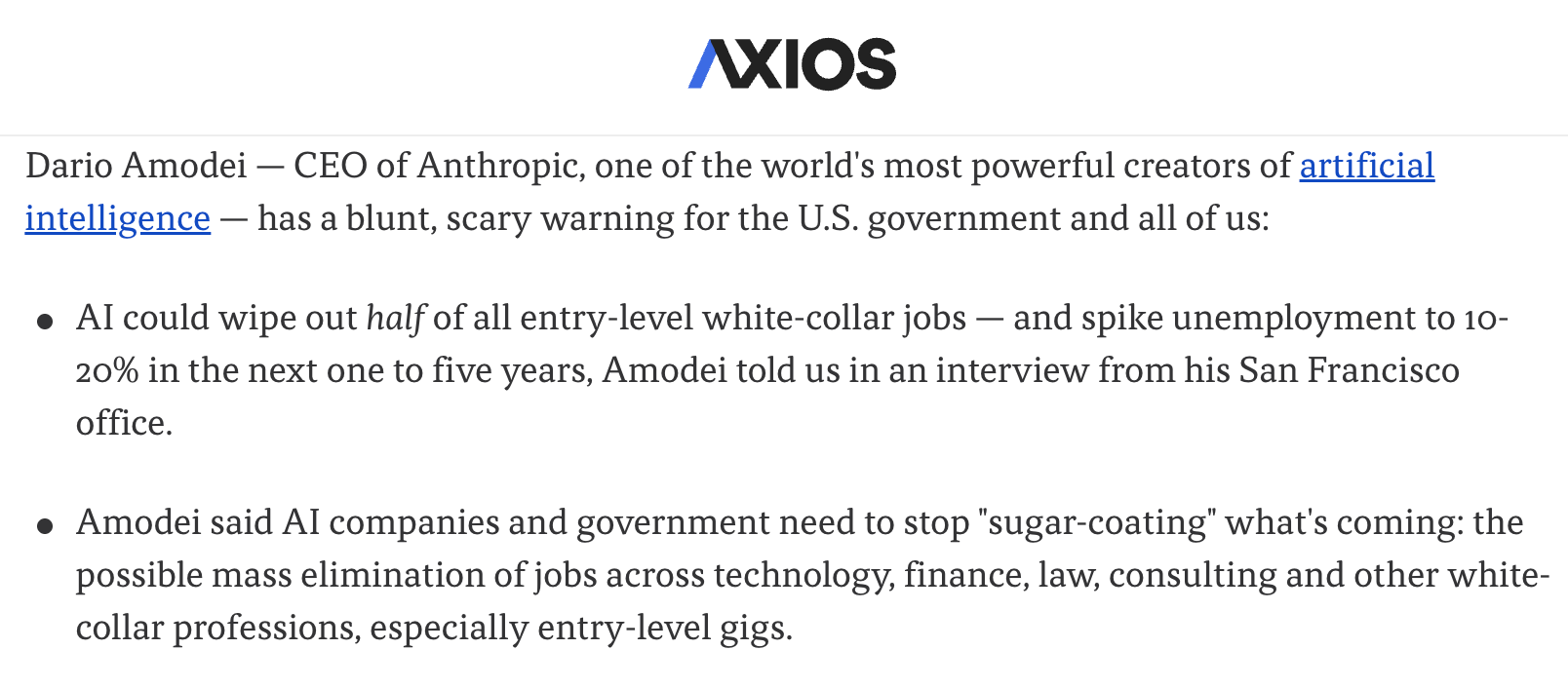
Cool. Awesome.
It’s at this point, though, that I have to acknowledge one of the dynamics that causes entire classes of people to start talking past each other.
For a certain slice of the political pie — including people I adore and respect like Tyler Austin Harper — all of this talk of job-pocalypse and/or actual apocalypse is just so much hype, all designed to inflate capabilities and raise expectations in pursuit of ever larger infusions of capital.


This is despite the people involved loudly announcing things like “this is not hype” and “really, this could kill everyone” in ways that are obviously not marketing stunts because they would give any actual marketing/PR/comms professional an aneurysm.


I’m not criticizing people within the labs for talking about the risks — it’s good that they’re saying it out loud. But many within the labs (which is in turn derived from habits within the related “rationalist” and “effective altruism” communities) seem to think that being honest is the same thing as being credible. It isn’t. You have to do the work of establishing credibility before it matters that you’re being honest.
And I do understand where the “it’s gotta be marketing” impulse comes from. Two companies that did not have a consumer product four years ago (one which started out as a nonprofit) are now on track for a combined run-rate over $100 billion and a combined valuation approaching $2 trillion — with employee tenders at $7B for OpenAI and a $6B offer for Anthropic12 earlier this year.
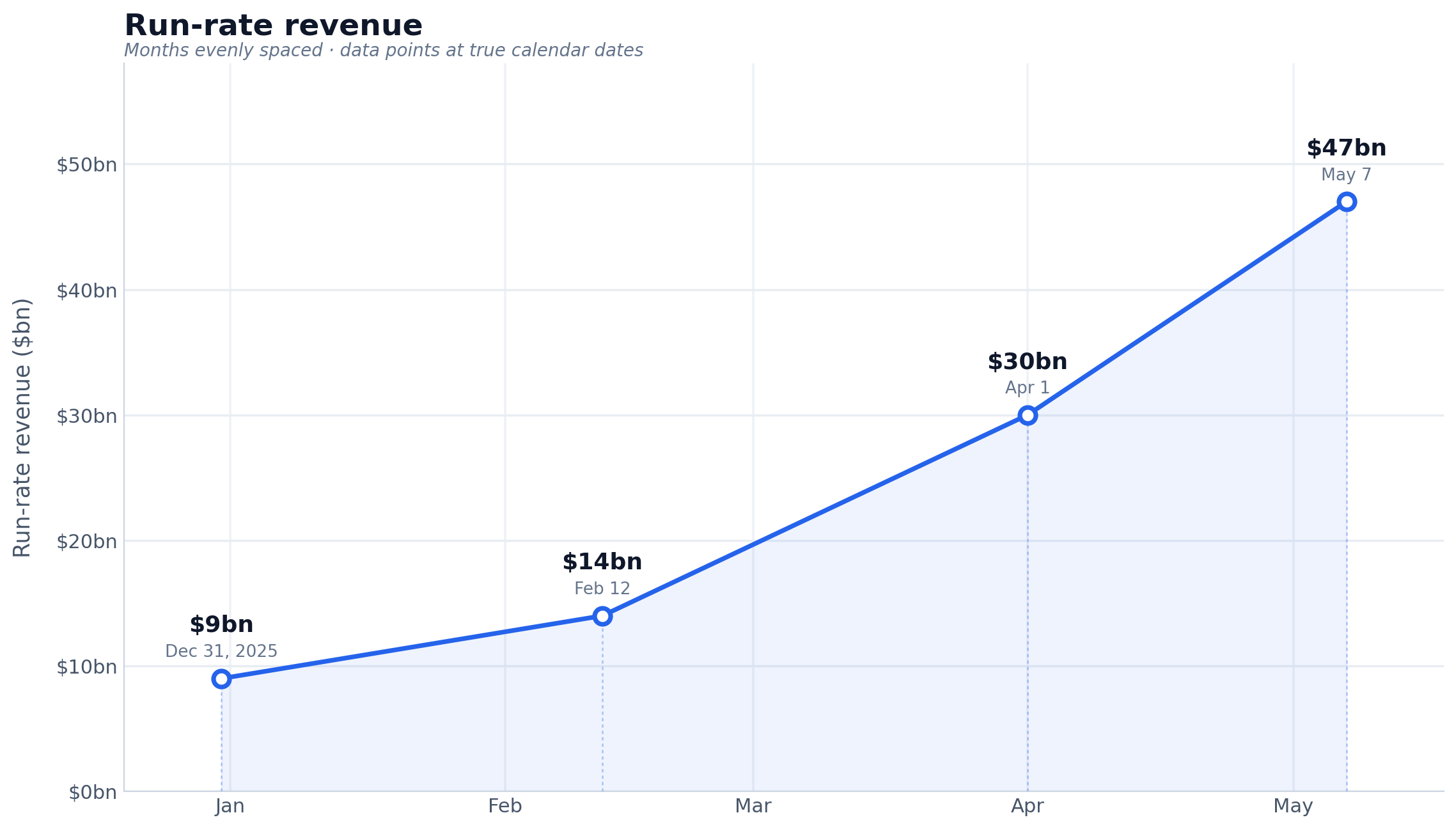
I mention the employee tenders not because Dario and Daniela Amodei aren’t doing well — Forbes puts their net worth at about $15.5B apiece — nor to skirt the fact that Sam Altman doesn’t actually have non-YC equity in OpenAI.
Rather, it just does create a material interest amongst precisely the same set of employees who are ‘sounding the alarm’.
I might personally believe they mean what they say, and I might personally think this level of revenue growth represents real demand for the product, and I also might personally get irritated by a mode of discourse wherein all disagreements are asserted to be driven by financial interests and not because good-faith actors see things differently. But critics are right to note that we really are talking about staggering amounts of money here.
Hey now, say now, I’m all about my yen.
The reason this dynamic is important is that it has resulted in this worst-of-all-worlds situation wherein:
The constituency that ordinarily would most enthusiastically bang the cowbell when it comes to “stopping billionaires from destroying the world” instead thinks it’s basically fake news; and
The knowledgeable insiders grabbing people by the shoulders and saying “the end of the world is nigh” are either a) called liars or b) greeted with a shrug, a ‘huh’, and the further stirring of some cereal.
Which — coming back to our homie posting up on the planks again — mirrors historically how this kind of thing seems to go.
The dude is all like:
“For then shall be great tribulation, such as was not since the beginning of the world to this time.”
“The sun shall be darkened, and the moon shall not give her light, and the stars of heaven shall fall.”
“As a snare shall it come on all them that dwell on the face of the whole earth.”
And what happened?
“They made light of it, and went their ways, one to his farm, another to his merchandise.”
I am, to be extremely clear, neither portending nor encouraging the literal or figurative crucifixion of various headliners within our frontier-tech billionaire class. Nor am I interested in getting into a whole debate about Biblical historicity, about which I probably already agree with you.
I just think issues of the kind we’re facing have a certain pedigree.
“By what authority doest thou these things?” asked the temple elders, of our man of many miracles.
Last year, on CBS, Anderson Cooper put a very similar question to Dario Amodei: “Who elected you?”13
Right now, lots of people are trying to figure out what the whole deal is with the kinds of technologies that have the power to shape and redefine our lives14 — should they be built, how should they work, and who gets to decide?
I personally think a useful lens through which to evaluate all of this is Simon Schaffer’s coinage “Promethean Science”, which he defines as “an experimental enterprise that mixes a vaulting ambition to safeguard humanity against a major threat with the troubling hazards of following this science’s recipes.”15
Its cousin is Promethean Technology: the science, applied — the part the rest of us actually confront.
One recent-ish example of Promethean Technology involves the rise of genetically modified plants — an issue which actually marked my first foray into politics as a researcher for Harold Ford, Jr. Nowadays we take it for granted16 that crops just work this way, but back in the early 2000s it was a major controversy.
And the way companies dealt with the controversy was — as Schaffer describes — by realizing they weren’t entitled to trust by default:
“The then head of Monsanto, Hendrik Verfaillie, spoke in Washington DC about the crisis surrounding genetically modified crops: ‘when we tried to explain the benefits, the science and the safety, we did not understand that our tone — our very approach — was seen as arrogant. We were still in the trust me mode when the expectation was show me.’”
It wasn’t about this or that benefit. It wasn’t about this or that risk. The problem was the arrogance involved in anointing oneself as the decider17.
That arrogance — embodied most of all by Altman’s “take our word for it” — is the one principal thing that rests at the root of all these AI conflicts:
The arrogance to ‘welcome’ you to the ‘era’ of your obsolescence;
The arrogance to dismiss as irrelevant your practical, day-to-day challenges;
The arrogance to act as though a miracle cure is inevitable;
The arrogance to toss around “extinction” and “FEAR” and “kill us all”;
The arrogance to build the tech anyway — while becoming kajillionaires.
And the sheer density of omnipresent, oblivious, irradiating arrogance is what is giving rise to our collective societal myoclonus of what-the-fuck.
I am not denying that these are powerful technologies. Indeed, I am by and large an enthusiastic AI booster. But the reason I’m belaboring an extended Jesus metaphor so insistently is that playing God is a claim to legitimate authority, not just rank power.
The decision to forgo the act of earning such authority is what society is punishing.


There are obviously a lot of distinctions between how Sean Davis and I tend to express ourselves. But I can’t help but agree that there is truth at the heart of the point he’s making about arrogance, humility, and a general understanding of the game that’s being played.
I’d tend to communicate the point more along the lines of what Ashwin Ramaswami points out here:


Or by emphasizing the agency we all retain, as Jill Filipovic reminds us here:


If AI is going to work out for us as a society, the labs’ fundamental orientation as institutions — what some folks within this space might describe as the objective function — has to start angling first and foremost towards trust. Towards legitimacy. Towards the admission that we all get to decide together.
Democratic legitimacy is not something one gets to bypass because it’s inconvenient.
The most important first step looks like an obsession with solving real, practical problems — “show me!” — rather than e.g. gratifying one’s own personal, meaning-providing odyssey towards the dawning of alien minds. And validating the importance of those problems by incessantly communicating it’s a real priority to solve them18.
A great approach is the kind adopted in this small-business spotlight from the AI company Owner, where the emphasis rests squarely on helping small business owners deploy websites, acquire customers, deal with paperwork, and streamline their workflows.
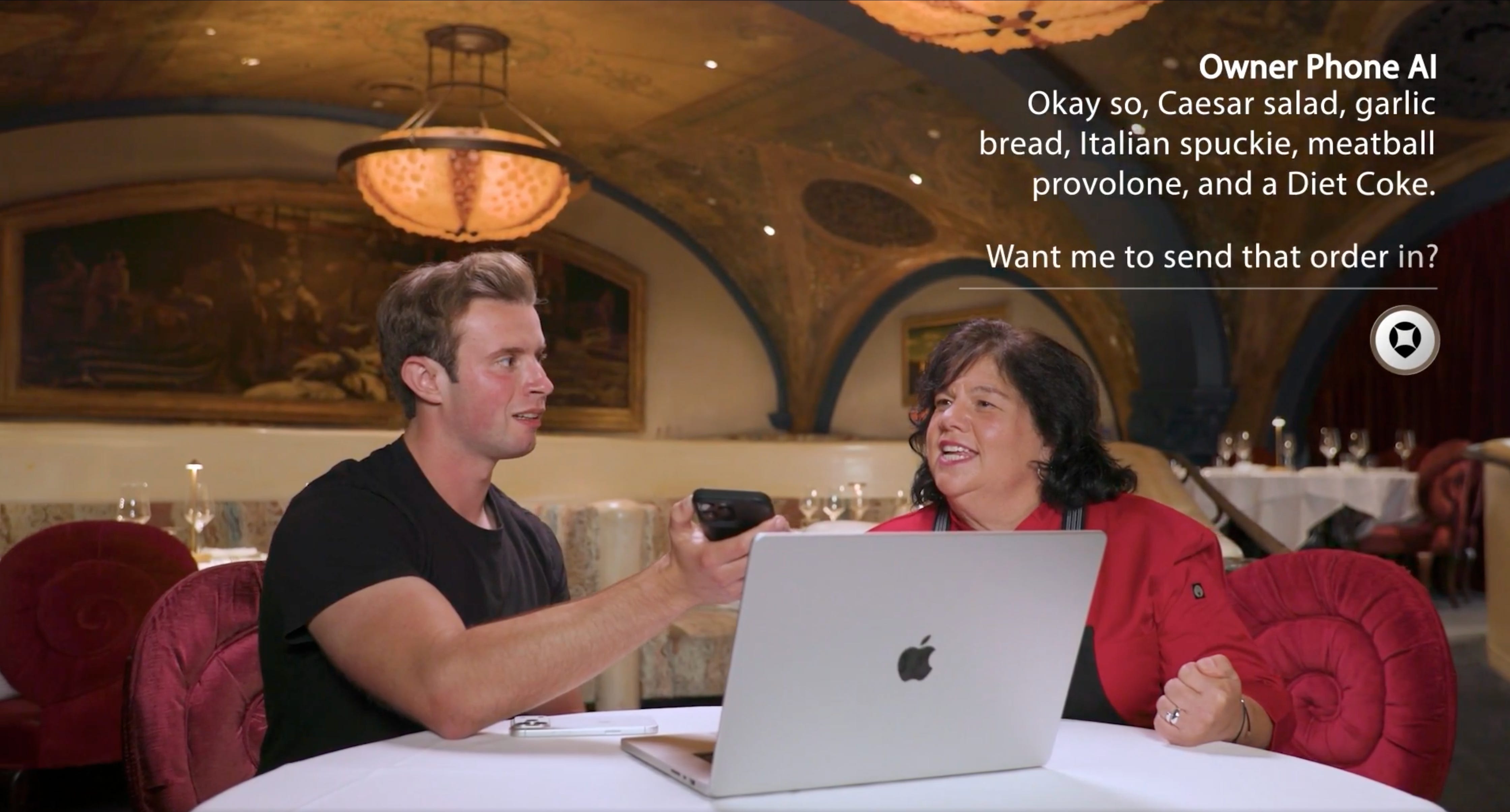
“It feels like the Jetsons,” says Lisa DeSisto, owner of Rig A Tony’s.
Hell yeah, it does.
I would also tend to agree with former Arnold Ventures VP of Public Finance Andrew Moylan that while math problems are going to be with us for a while, it’s going to be hard to get data centers built without showing the public how AI stands to benefit them and their communities today.
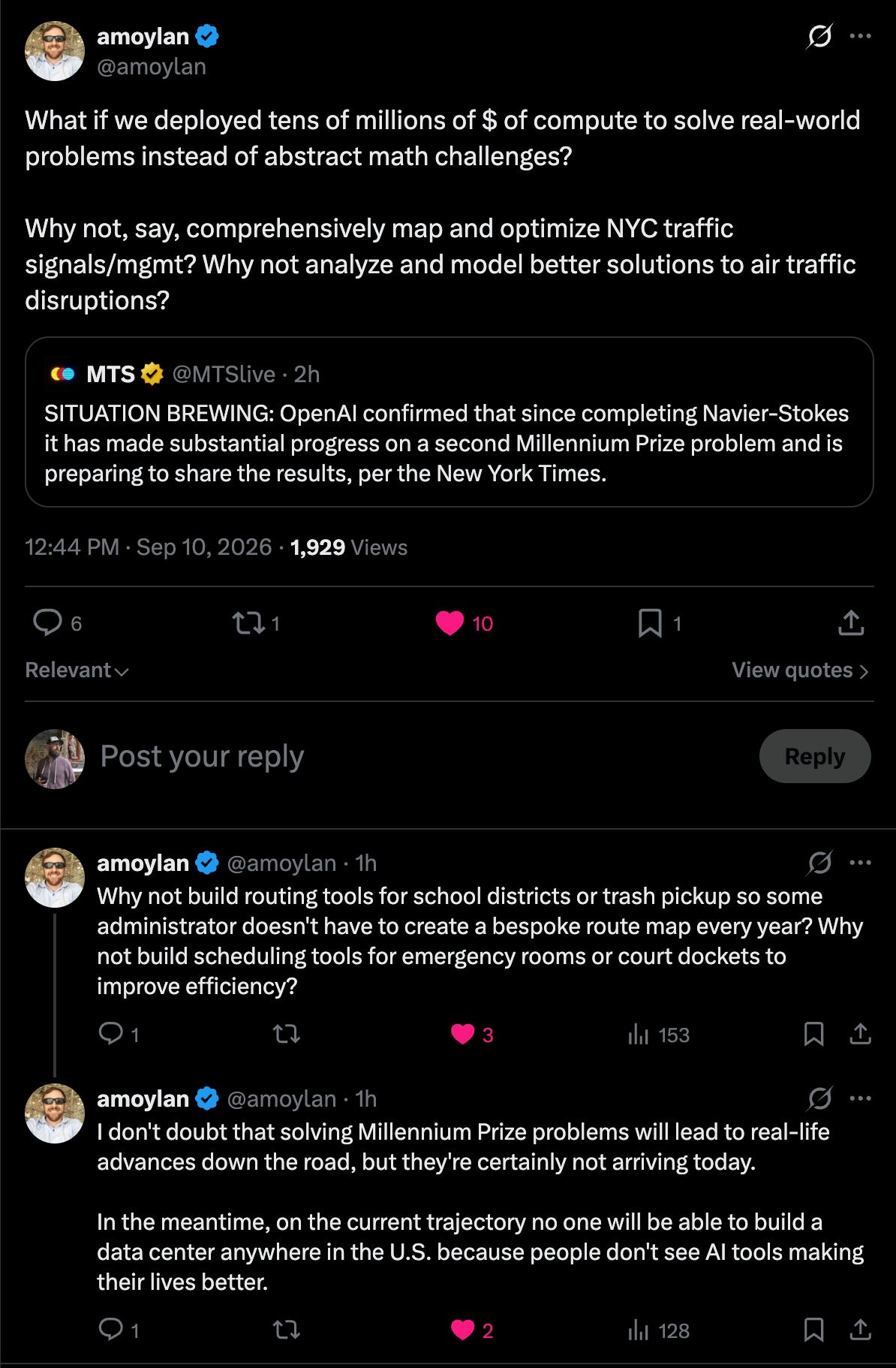
What has to stop is the self-congratulation exercise involved in crowning oneself The Decider, entitled to consign the rest of the world to the permanent underclass.
You play God, you gon’ get what you ask for.
Of course, you don’t have to take my word for it that there’s wisdom in anchoring on the toils and troubles of regular people — despite, and indeed because of, one’s own immense and unparalleled power. Our guy had a few things to say about that, too.
“He that is greatest among you, let him be as the younger; and he that is chief, as he that doth serve.”
“If I then, your Lord and Master, have washed your feet; ye also ought to wash one another's feet.”
“The greatest among you will be your servant.”
The question for those who would play God is: who among you is great enough to serve?
We’re pretty sure?
Relevantly, this is not that different from the way I described the iPod, just as the refrigerator and dishwasher are both appliances that are enabled by electricity. I think that’s revealing, actually — the job of good advertising is to cross the bridge from the abstract capacity to the concrete singular value proposition at the level a given person can viscerally understand.
Altman also emphasized the same point at the same event, even more definitively: “We will be amazed at how quickly we’re curing this cancer and that one and heart disease.”
Not to be outdone, DeepMind founder and former CEO Demis Hassabis actually goes a step further, asserting “I think one day maybe we can cure all disease with the help of AI” in a 2025 CBS interview.
In general I’ve started to believe the usage “labs” (rather than e.g. “AI companies”) has become a bit misleading, though it’s still helpful to be able to differentiate “the particular institutions developing the main frontier models”.
The context of this interview was about a shift in the labs’ messaging strategy, which Altman said should evolve in the direction of (among other things) creativity and entrepreneurship.
The Fred Rogers piece of wisdom about “I’m going to do something really little tomorrow” is perhaps especially relevant here.
“If there is one lesson to be drawn from the controversy in Europe about genetically modified organisms (apart from a reminder of the unwelcome influence of mass media), it is that technologies are less likely to gain easy acceptance until they can demonstrate tangible benefits to potential customers.”
-Philip Ball, “Making Stuff: From Bacon to Bakelite”
One thing that’s hard about writing a piece like this is that, for those uninitiated in the discourse, it feels like I just have to be cherry-picking select apocalypse-harbingering quotes because of how insane they sound. Whereas for those of us steeped in it, there are literally dozens if not hundreds of such examples coming from household-name-tier CEOs alone. If you’re less than familiar, trust me when I say that this stack of assumptions is table stakes.
Anthropic couldn’t actually complete the tender offer, because employees valued their own shares so much.
Dario actually handled himself extremely well in this interview — he was keenly aware of the power and legitimacy dynamics we’re talking about and in fact actively attempted to make the point that the lack of them was a gigantic problem.
AI itself, but also things like data centers and power plants and autonomous weapons of war.
I encountered this essay, “Charged Atmospheres: Promethean Science and the Royal Society”, in Bill Bryson’s classic compilation “Seeing Further,” a collection of essays on the Royal Society — but I can’t find a copy online. Interestingly, it’s an article about lightning rods, which rhymes with Arthur R. Miller’s description of data centers as a “lightning rod for the vague feelings of discontent generated by the computer revolution.”
At least here in the US — Europe is a different story.
This is a lot like what Jasmine Sun talks about when she talks about thymos, the fight over data centers as stages for the recognition of regular people’s essential dignity and worth — a fight, people are realizing, they’re actually set up to win.
This is not distinct from recognizing that the technology is plausibly an important national-security interest; internal productivity tool; etc. The point I’m making is about product, not technology.
Holy shirtballs...what a ride!
Okay, so, this is an immediate follow for Zac ~ it was an obvious READ when I saw that Charlotte Clymer had shared it, because I respect HER so much.
It makes me want to have a conversation WITH Zac, because I now have so many thoughts in my head spawned by this article, but also would leave me too intimidated because I'm clearly a word butcher and dolt by comparison.
This.
Writing.
Even divorced from the topic, just...THIS WRITING!!
Captures so much of where I am on AI as tool and danger and expression of tech bro narcissism, but also curing cancer and quickly doing the types of search that traditional "engines" were always trash at ~ like, let's just slow its roll and sort out WHAT we're doing and HOW and WHY before it's all just a fait acompli?
Anyway, will be sharing this further, because YOWZA!
I feel like one distinction that’s missed in the comparison to ads for e.g. electricity of yore is that there are two forms of advertising happening right now. On one hand you have the blog posts, interviews, twitter feeds, etc. of the heads of the labs who are playing one game, and then the actual marketing from the company playing another.
The target of Amodi and Altman’s approach (where things can only ever get bigger) is fully and deeply related to the Silicone Valley approach of big visions get capital, small solvable problems don’t. This article does mention that this game of marketing may be pointed at investors/regulators, and I think that’s true.
What’s missing is the other game, where OpenAI and Anthropic *are* actually fighting each other in practical marketing directed towards individuals, with the ads being things like “help me plan a workout” or “how do I change a tire”. This is exactly the kind of concrete scoped tasks the article argues they should be focusing on, “thinking smaller”.
My point here is that in the age of terminally online VC’s and investors living on twitter, you can’t conflate the two games and historically the first game was happening all the same, just there wasn’t a twitter to watch it play out.